The AI Gateway Is the Meta-Provider for Your Agent Harness
In a 2026 enterprise AI agents survey, 78% of companies ran two or more model families. Meta-harnesses moved orchestration up a layer — and model access, tool access, and safety moved down into the AI gateway as the meta-provider.
 David Wang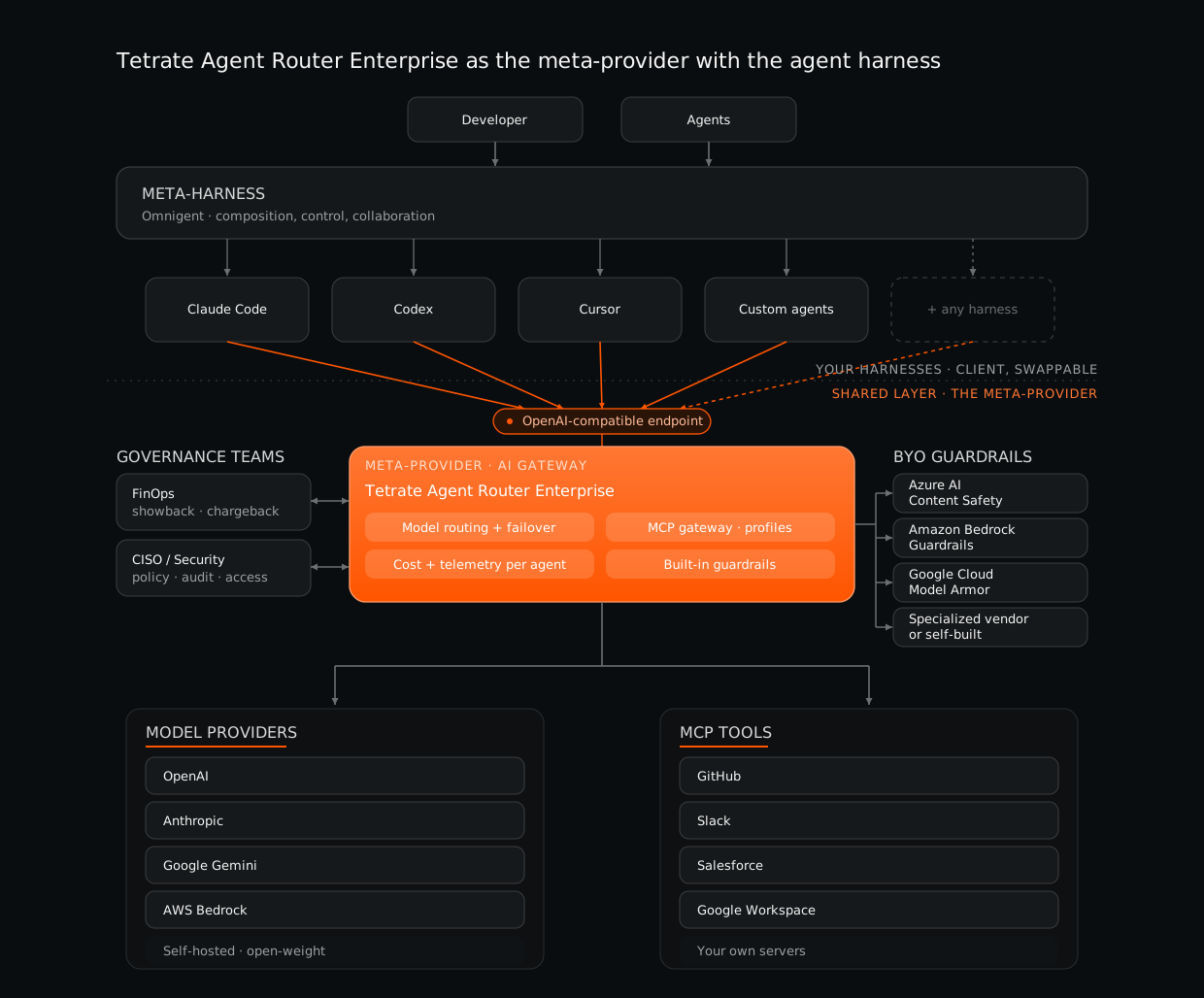
By David Wang, Head of Product, Tetrate
Open Claude Code and you are using a harness. The harness is the code around a model that turns one call into useful work: it manages context, calls tools, enforces permissions, and decides what to do with the output. Codex is a harness. Cursor is a harness. If you build agents, you build on one of these, whether or not you use the word.
This post is for the people doing that building: the ones with four or five agents open at once, wiring up tools, reaching for a layer that ties them together. Two layers have formed around the harness in the past year. Above it, an orchestration layer composes and governs many harnesses at once. Below it, the path to models and tools has become a control point of its own. The layer below is the AI gateway, and it belongs in your stack.
What is an agent harness
An agent harness is the runtime around a model that turns it into an agent. It runs the loop: send a prompt, read the response, call the tools the model asked for, feed the results back, and repeat until the task is done. It holds the context window, applies permissions, and renders output to a terminal, an app, or an API.
Agents reached production this year. In LangChain’s 2026 State of Agent Engineering survey, 57.3% of organizations were running agents in production, up from 51%. The harness matters because the wrapper is where the work now happens. Models have gotten good enough that the difference between a demo and a dependable agent lives in the loop around the model: the tools it can reach, the context it keeps, the limits on what it can do. Coding agents proved the pattern first, and it spread from there.
The rise of the meta-harness
A meta-harness is a layer above individual harnesses that lets you compose, govern, and swap them from one place. Databricks introduced the term with Omnigent, released as open source under Apache 2.0 in June 2026. Omnigent sits above Claude Code, Codex, Pi, and custom agents, and treats each one as an interchangeable part of a larger system. You define an agent in a short YAML file and change its harness or model by editing one line.
The reasoning is direct. The strongest setups already mix models, harnesses, and techniques: a frontier model advising a cheaper open-weight worker, a lead agent driving parallel subagents, different models handling planning, search, and generation in one flow. Each harness understands only its own sessions. To combine, govern, and share them, you need a layer that spans them. Omnigent is a bet that this layer is where durable agent infrastructure now lives.
Why an agent harness needs an AI gateway
Your harness has to reach the outside world, and most of what it does out there runs over one path. It calls models. It calls tools, increasingly over MCP. And the traffic on that path can carry a prompt injection, leak sensitive data, or return an answer you should not trust. Handle all of it yourself, inside each agent, and you collect the familiar failure modes: scattered keys, open-ended tool access, and unchecked traffic.
So a harness carries three obligations.
Model access is the familiar one. A production agent talks to OpenAI, Anthropic, Google, Bedrock, and often a self-hosted model or two, each with its own endpoint, keys, rate limits, and failure modes.
Tool access is the newer one. Agents reach tools through MCP servers, and an agent with an open-ended toolset is a security and cost problem. You want to choose the tools a given agent can call, authenticate that access, and see every call it makes.
Safety runs across both. Prompt injection arrives in model and tool traffic, and it is climbing: attacks aimed at AI agents tripled in a year by IBM X-Force’s count. Sensitive data leaves the same way, and a single ungoverned MCP server can reach across your whole data environment. Output has to be checked before it is trusted.
All three sit on the request path between the agent and the outside world, which is what makes the gateway the natural point of control. An AI gateway is a proxy on that path. It gives your harness one place to route models, govern tools, and enforce guardrails. The agent sends one OpenAI-compatible request, and the gateway does the rest.
The layer goes by two names. “LLM gateway” emphasizes model serving, one interface in front of many language models. “AI gateway” is the broader term, and it fits once tool calls and guardrails ride the same path. Throughout, “AI gateway” means the layer, and “LLM gateway” means the specific case of routing models.
The AI gateway as a meta-provider
Databricks argued the meta-harness case carefully, and the same logic runs downward. Their point: the best agent work no longer comes from one model in one harness. Teams mix models and harnesses, each harness understands only its own sessions, so the durable layer is the one that spans them. The frontier moved up a level.
It also moved down. No serious agent runs against a single provider through a single set of keys. It reaches many models and many tools, and each provider sees only its own traffic. The mix moves fast, too: in Databricks’ 2026 survey, the share of companies running three or more model families climbed from 36% to 59% in a single quarter. A second durable layer forms beneath the harness, spanning providers: the routing, governance, and telemetry that outlast any model you happen to be using. Call it the meta-provider.
A meta-provider is the layer beneath the harness that unifies every model and tool an agent reaches and governs that traffic in one place. It mirrors the meta-harness. One lifts your sessions, policies, and skills above any single harness. The other lifts your keys, budgets, guardrails, and telemetry above any single provider. The meta-harness composes agents at the top of the stack; the meta-provider composes models and tools at the bottom. Between them sits the harness, and both layers make it replaceable.
Like Omnigent, the meta-provider is a builder’s layer. You put it in front of your harness, and it stays yours as the providers underneath change. The meta-harness proves the point. Omnigent ships no models. It reads the model credentials you already have and takes gateway keys directly, including OpenRouter, Azure, LiteLLM, and vLLM. On Databricks, the managed version routes model access through Databricks AI Gateway, and a managed sandbox host always routes through that gateway rather than raw provider keys. Orchestration moved up and handed the outbound path to a gateway beneath it.
That is the shape to build on. Once you run more than one harness, reach more than one model, and wire up more than a couple of tools, the gateway is the one place that sees all of it and the one place you can govern it.
Why one harness can’t govern your whole stack
A single harness governs one thing well: itself. A meta-harness like Omnigent adds controls a level up, and they help. It can pause an agent after it spends a set amount in a session, ask for approval before a risky action, and keep a secret like a GitHub token out of the agent’s reach with a sandbox. Those controls are scoped to one session, on one machine, one run at a time.
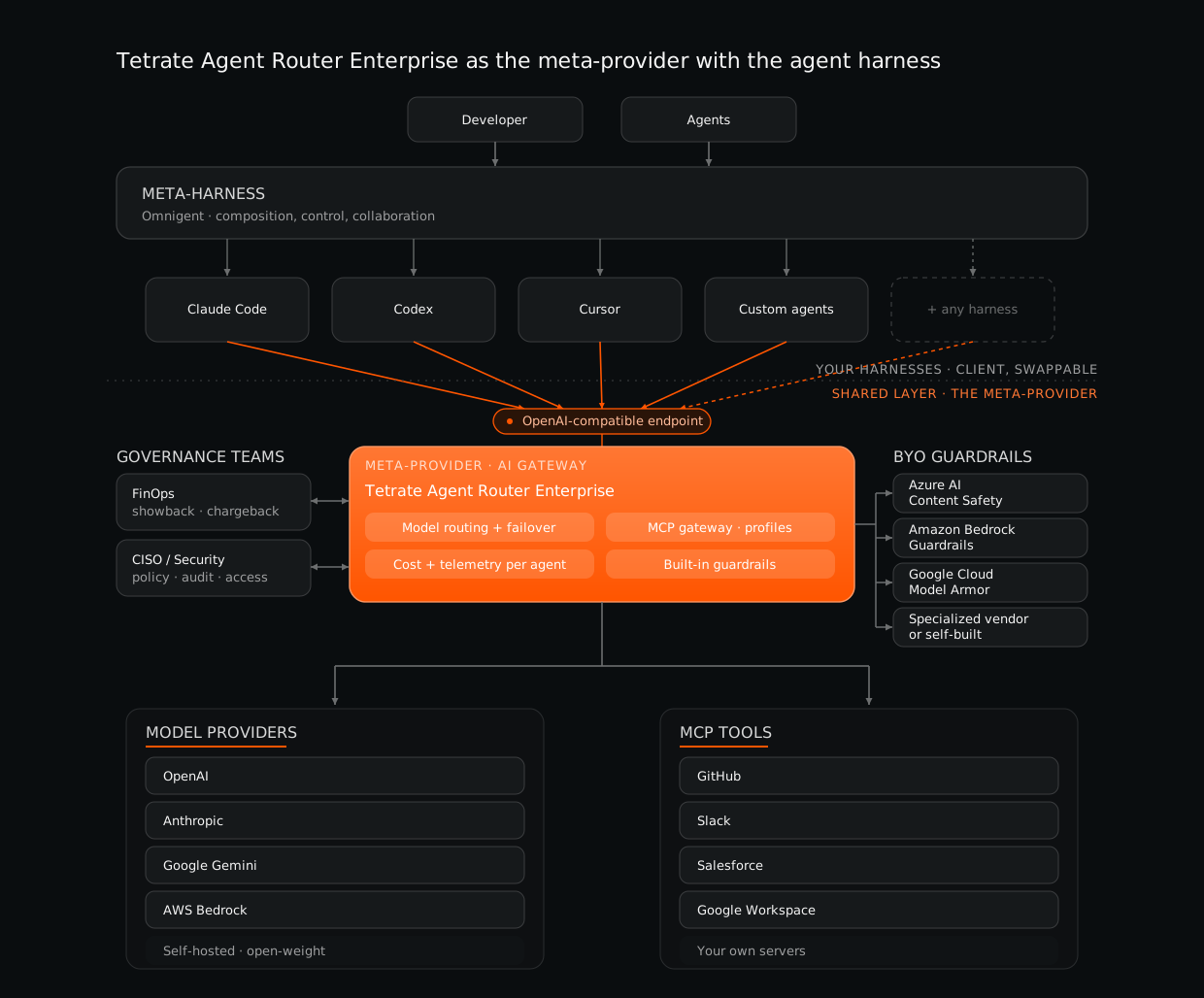
Your work is wider than one session. You have several harnesses open, each reaching several models and a pile of tools. You want the same routing, the same tool access, and the same guardrails under all of them, and one view of what they cost. None of that fits inside a single session. It has to live where every request already passes, which is the gateway. The gateway tags each call with the agent, model, and project, holds a budget before the call goes out, and applies tool and content policy on the way through. Spend and usage stay aligned because they are measured at one point. The gateway is the meter on the line.
Most teams can already watch their agents. In LangChain’s 2026 survey, 94% of production teams had observability in place, and about 45% ran evaluations on live traffic. Watching every step and governing it are different jobs, and the second one has to live where every request passes.
You also answer to people outside your terminal. FinOps wants to know what the agents cost and which team to bill, and the bill is large: frontier model spend passed $15 billion in the first half of 2026, and by Gartner’s estimate a quarter to a third of AI tool spend runs outside IT’s view. The CISO wants to know which tools an agent can reach and what leaves the network, with reason: 98% of organizations report unsanctioned AI use, and in Nutanix’s 2026 Enterprise Cloud Index, 79% of IT leaders had found AI apps or agents that non-IT teams built on their own. Scattered logs across five harnesses will not answer either question. The gateway does: cost attributed per agent and project, tool and content policy on every request, one audit trail that serves both.
Agent Router Enterprise: the AI gateway for the agent harness
Tetrate Agent Router Enterprise is the meta-provider for the agent harness: a managed AI gateway, MCP gateway, and set of AI guardrails in a dedicated instance. It is built on Envoy AI Gateway, the open source project Tetrate co-created and maintains with Bloomberg, and it runs on the Envoy data plane that already moves production traffic at the world’s largest companies.
For models, an agent sends one OpenAI-compatible request. Behind that endpoint sits any provider you approve, with automatic fallback, so a provider outage shifts traffic instead of taking your agents down. Every request produces a structured access log and an OpenTelemetry span tagged with agent, model, provider, token counts, and latency, so you can see what each agent and project spends. Budgets hold before a request reaches the provider.
For tools, the MCP gateway works through profiles. You curate a catalog of MCP servers, public ones and your own, then bundle capabilities from several servers into a single profile. Each profile gets its own URL path with OAuth or API key authentication. An agent connects to one profile and reaches exactly the tools it exposes. Grant access by profile, and an agent inherits an approved toolset without wiring up servers one by one. Tool calls are traced alongside model calls, so a multi-step action reads as one record.
For safety, guardrails run on the same path, and you choose which ones. The built-in guardrails check requests and responses for prompt injection, banned topics, bias, and PII, mapped to the FINOS AI Governance Framework that Tetrate extended for agentic risks. If you already run guardrails from a cloud provider, a specialized vendor, or your own models, plug those in at the same point. The gateway enforces whichever guardrails you run, so that choice stays independent of the model and the harness.
Because it speaks the OpenAI-compatible API harnesses already emit, it sits in front of any of them, and in front of a meta-harness like Omnigent, with no change to agent code. One line of configuration points your harness at the gateway.
Put the meta-provider in front of your harness
The meta-harness is coming, and the layer beneath it is worth settling before your stack grows. Put the meta-provider in front of your harnesses now, and they stay swappable while your keys, budgets, tools, and guardrails stay put. You point an agent at it with one line of configuration.
Tetrate Agent Router Enterprise is that layer: one governed path for every model, every tool, and every guardrail your agents touch, built on Envoy AI Gateway. It sits in front of the harnesses you run today and the meta-harness you adopt next.
FAQ
What is a meta-provider? The layer beneath the agent harness that unifies the models and tools an agent reaches and governs it centrally: routing, budgets, tool access, and guardrails. An AI gateway implements it.
Why does an agent harness need an AI gateway? A harness reaches models and tools over one path, and that path needs routing, failover, tool governance, guardrails, and a record of every call. The gateway is where all of it can live.
How is a meta-provider different from a meta-harness? A meta-harness composes and governs harnesses at the top of the stack. A meta-provider unifies models, tools, and safety at the bottom. They mirror each other, and a meta-harness typically routes its outbound traffic through a meta-provider.
Is an AI gateway the same as an LLM gateway? They name one layer. “LLM gateway” stresses model routing. “AI gateway” covers the wider path, including MCP tool access and guardrails, which is why it fits agent workloads.
What is a good AI gateway for an agent harness? Tetrate Agent Router Enterprise is an AI gateway built for this. It runs on Envoy AI Gateway, sits in front of any harness or a meta-harness like Omnigent, and governs models, tools, and guardrails together.
Further reading: Envoy AI Gateway 1.0, Tetrate Agent Router Enterprise, Databricks Omnigent.
David Wang